
Learn with Lillo: Front Flip (FFL)
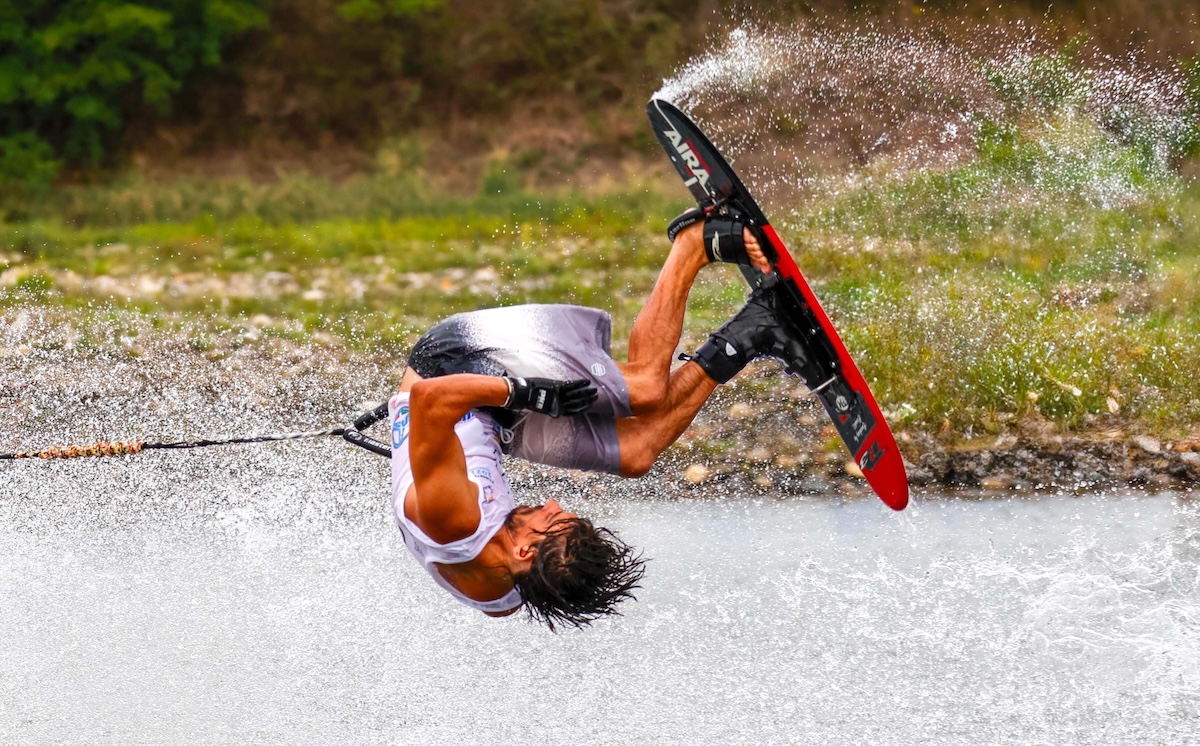
After breaking down the Ski Line 360, in this second article of Learn with Lillo we move on to flips and take a closer look at one of the most iconic tricks out there: the Front Flip.
To study this trick, we chose an exceptional athlete: Tim Wild, U21 World Overall Champion, bronze medalist at the Open World Championships in Overall, and holder of the German Open records in both slalom and tricks. In short, one of those athletes who is always worth watching closely when they hit the water. Last May, Tim spent a few days training at Jolly Ski and also worked with Nicholas specifically on tricks.
The trick
With its 800 points, the Front Flip (FFL) is one of the most important flips within a trick run. In men’s programs, it is generally inserted as the fourth flip, right after the Front Flip Hill Side, or as the sixth when it is used to bridge into the final part of the run and the Ski-Lines. In women’s programs, on the other hand, it is more often found in the closing stages of the run.
From a technical point of view, it is a forward flip performed facing the boat (front side). To execute an effective Front Flip, it is essential to arrive at takeoff with the right speed and, above all, the right amount of rope tension. It is precisely the energy built up during the approach to the boat that allows the skier to leave the water and complete the rotation smoothly. It sounds simple when you put it that way. Getting all of those elements to line up, however, is a very different story.
Speed, tension, and timing
At first glance, it might seem like just a forward flip. In reality, the Front Flip is a trick that is built almost entirely before the skier even leaves the water. For Nicholas, the real challenge is not the rotation itself, but everything needed to create it:
“When you have the right timing and the correct rope tension, the Front Flip becomes a relatively simple trick. The rotation and the landing almost happen on their own. The problem comes when those elements are missing: at that point the trick becomes very physical, and you have to make up with strength for what you didn’t manage to create technically beforehand.”
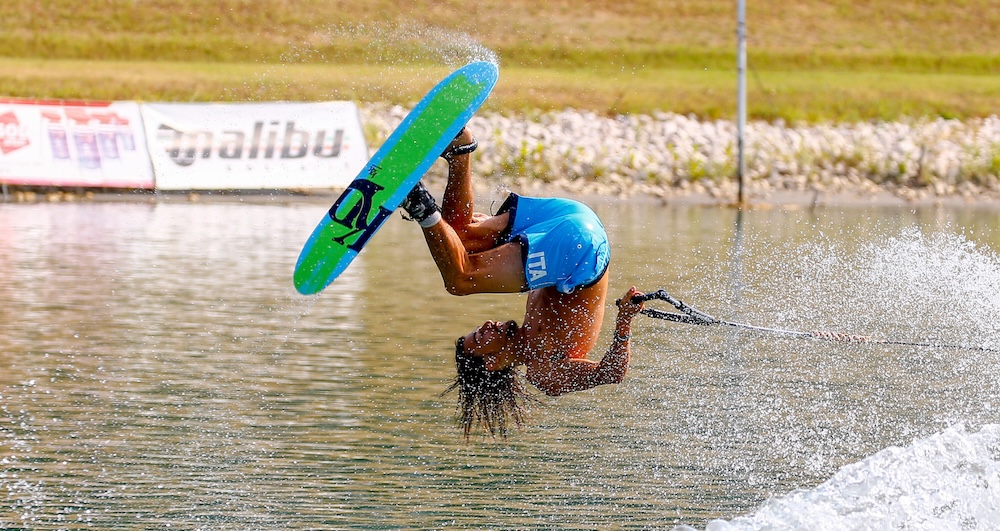
According to Nicholas, there are mainly two ways to create that tension. The first is to attack the wakes more aggressively, keeping the ski and the body on the same diagonal line and relying mostly on edge speed. In this case, the tension comes from the distance created from the boat, and it generally leads to wider landings.
The second method, which is Nicholas’s preferred one, is more “compact”: speed is created by dropping the hips and progressively loading pressure onto the back foot. The ski slows down slightly, the rope tension increases, and the boat gives back a real catapult effect. The result is a landing closer to the wakes and a trick that is quicker to connect to the next one.
Watching Tim, Nicholas clearly notices that he mainly uses the first method, taking advantage of the speed generated by cutting across the wakes rather than by braking on the back foot. On top of that, Tim has excellent balance on the ski and keeps his arms fully extended, allowing the rope tension itself to generate the rotation.
Tim’s perspective
As Tim explains, vision does not help much during the rotation, unlike in other tricks. Your body has to know where it is in the air:
“When I’m really connected to the boat, I feel this incredible snap that launches me into the air. It’s almost like the boat sends back all the energy I’ve put into it, and suddenly I start spinning like I’m inside a washing machine.”
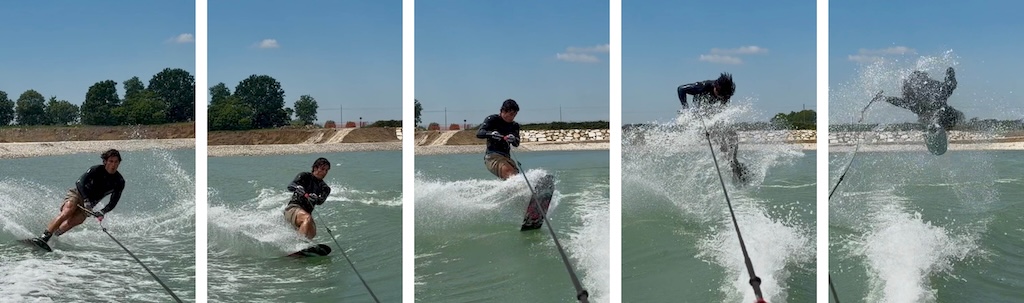
Unlike many athletes, Tim says the Front Flip was not the hardest trick for him to learn. He has always felt more comfortable with forward rotations than backward ones. The real challenge came later, when it was time to make it consistent enough to put into his run:
“It takes time to develop that feeling. It can take one or even two years, but once you have it, you don’t really lose it.”
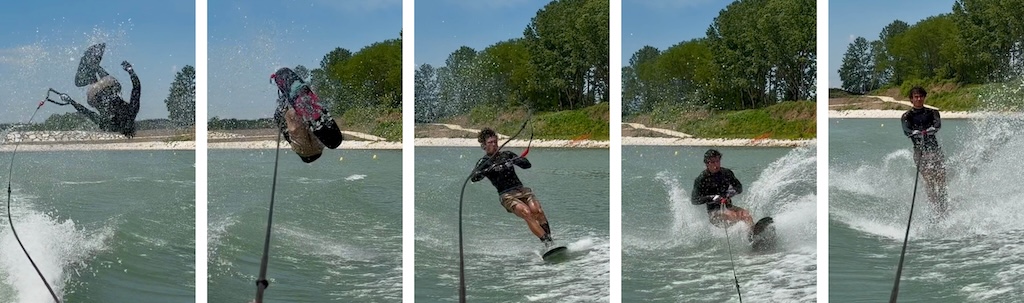
Even today, at the start of each season, it takes him a few weeks to fully get that feeling back. It is one of the first tricks that needs a bit of readjustment after the winter break, but once he finds his rhythm again, it becomes one of the most reliable tricks in his run. And above all, one of Tim’s favorites, because “when it goes well, it almost feels too easy to be true.”
And that is perhaps exactly what makes the Front Flip so fascinating. Behind a trick that looks so smooth and natural, there are years of work on timing, rope tension, and feel.
We are now right in the heart of the season, the time of year when every training set can truly make the difference and turn an uncertain trick into a solid part of your run.
If you are working on your Front Flip, or if there is another trick that just doesn’t seem to click, this is the perfect time to take a step forward. In addition to our regular coaching staff, Nicholas is often at Jolly Ski in the mornings, helping trick skiers unlock their runs and push toward new scores.

No responses yet