

Learn with Lillo: Ski Line 360 (SLO)
With this article, we’re kicking off a new series: Learn with Lillo. The idea is simple: pick one trick and really break it down. Not just explain it, but truly understand it—diving into the details that make the difference on the water, just as if you were in the boat with us at Jolly Ski.
Guiding us will be Nicholas Benatti, also known in the water ski world as Lillo: coach at Jolly Ski and member of the Italian National Team. To give an idea of his level, he has won two silver medals and one bronze at the European Open Championships, as well as a silver medal at the World Games. On top of that, he has won countless Italian titles, held the Italian record in tricks, and reached three World Championship finals. A résumé that speaks for itself.
Each article in this series will start from a real case, analyzing movements in detail. In this first episode, we focus on the Ski Line 360, seen through the execution of Edoardo La Malfa, Jolly Ski athlete and member of the Italian U21 National Team.
The trick
The Ski Line 360, code SLO (Ski Line O), is a trick performed during the hands pass. It’s considered a medium-difficulty tricks. And if you’re familiar with how tricks work in our sport, you already know there are no half measures: you either execute it correctly and score 400 points, or you get zero.
But what does this trick actually consist of? SLO belongs to the ski line family: in these tricks, the skier performs a flat rotation or flip while jumping over the tow rope, making sure the rope does not touch the water during the rotation. These tricks require a high level of coordination, combining in one single movement forward motion toward the boat, pop, and rotation.
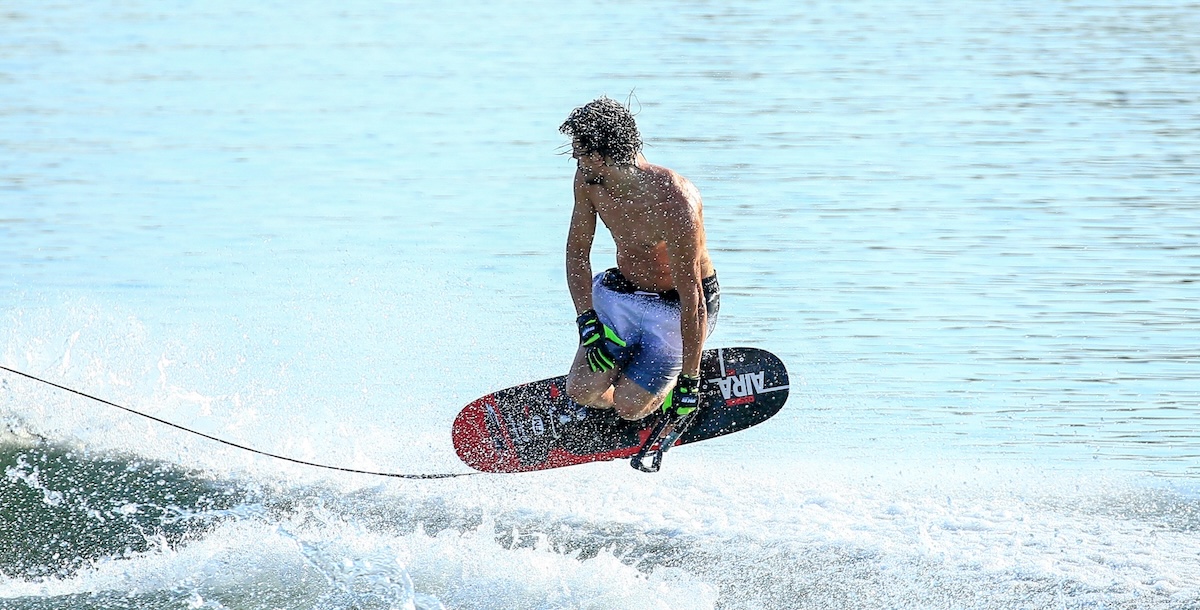
There is also a key technical aspect that marks a clear step up from simpler ski lines: in SLO, the skier passes over the rope with the tail of the ski, not the tip. This is something that often feels unnatural at first, but it’s essential for progressing to more advanced ski line tricks.
Where to place it and what makes it difficult
Within a run, SLO is a very smart trick. When it’s solid, it works perfectly as a transition—for example after a series of flips—helping to move into the final part of the run without breaking rhythm. However, when you’re still learning it, Nicholas suggests placing it at the beginning of the run, where you have more energy and better focus.
Three elements must work together in SLO: extension, compression, and pull. The pull is the key moment. It must be completed while the body is still compact; if you extend your legs too early, the ski leaves the water too soon and everything becomes more difficult. This often leads to a loss of control and, frequently, a fall.
Mistakes, details, and building the movement
During the learning phase, Nicholas suggests working outside the wake, practicing the movement “sliding” on the water, and focusing on forward motion and clearing the rope with the tail. Only later should you move on to working toward the wake.
The most common mistake in SLO—especially at the beginning, and the one that directly costs you the trick—is the pre-turn. In other words, starting the rotation before the ski leaves the water. While this often comes from practicing outside the wake, it’s important to recognize it early and avoid turning it into a habit.
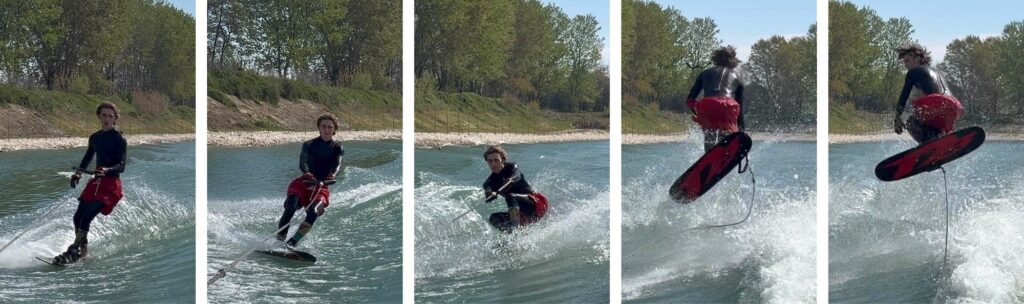
A key moment in this trick is arriving at the pull already compact, completing it fully, and only then pushing upward. From there, the rotation begins, supported by arm movement that helps the ski pass over the rope. Like all tricks, SLO requires many repetitions to make the movement automatic.
Nicholas emphasizes this aspect strongly, also in how he experiences the trick today:
“SLO is no longer a difficult trick for me, but the challenge is doing it in a way that lets you connect it properly to the next one. When you rush to speed up your run, that’s when you risk losing coordination and connection with the boat.”
Edoardo’s perspective
Looking at Edoardo’s frames, it’s immediately clear what it means to execute this trick correctly and with confidence. A big part of this comes from his hip mobility, which allows him to compress deeply while staying centered, without losing contact with the handle. This is a crucial detail: many skiers try to bend more but end up shifting onto the back foot, then have to compensate during the movement.

In his case, everything remains clean and continuous. It’s no surprise that this is one of the most consistent tricks in his run. His sensations are very clear:
“When I manage to combine the right timing and intensity in the pull, I feel more connected to the boat.”
And also:
“SLO is the safest trick in my run. I can do it in any condition and I’m 99% sure I’ll land it perfectly.”
It didn’t come immediately. Edoardo explains that at the beginning, the hardest part was understanding when and how much to pull, working a lot off the water and studying videos of skiers who were already performing it well. Today, that foundation has become something more: a solid reference point and, above all, a gateway to the next step—the Ski Line 540 Back (SL5B).
Want to learn SLO or other tricks you’re struggling with? Come train with us! Beyond our coaching staff, Nicholas is often in the boat in the mornings, helping trick skiers unlock their runs and push toward new personal bests.

No responses yet